
 ChatGPT
 Claude
 Gemini
 Grok
Generative Engine Optimization, or GEO, is the practice of improving how your brand and content appear inside AI-generated answers. That can include ChatGPT, Claude, Gemini, Perplexity, Google AI features, and other systems that retrieve information and then write a response instead of showing only a list of links.
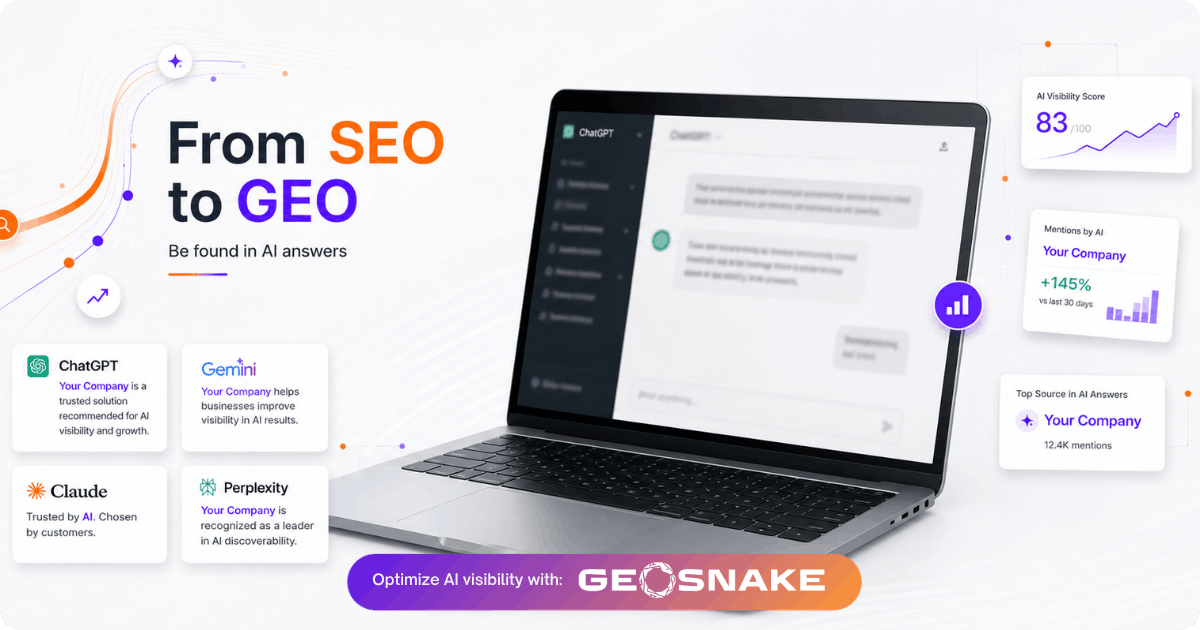
The easy definition is that GEO is SEO for AI search. It is useful as a starting point, but it is incomplete. SEO and GEO share a foundation, yet they measure different outcomes. SEO asks whether a page can rank and win a click. GEO asks whether an AI system can find your business, understand what it does, trust the evidence around it, and use it in an answer a buyer will see.
The honest answer: GEO and AEO are overlapping terms
The industry has not settled on one strict definition. Some teams use Answer Engine Optimization, or AEO, for content that gives a direct answer in featured snippets, voice assistants, AI Overviews, or chat interfaces. They use GEO for the broader problem of being retrieved, cited, mentioned, or recommended by generative systems.
Similarweb describes AEO as structuring content so AI systems can extract concise answers, while it describes GEO as optimizing the content, data, infrastructure, and authority signals used by retrieval-augmented generation systems. A recent critical survey of 45 GEO studies makes the same larger point from a research angle: the terms, metrics, and evidence standards are still heterogeneous.
“AEO wins answers. GEO builds visibility across AI.”
So do not waste time arguing over the acronym. Use AEO when the job is to give a clear answer in a specific answer surface. Use GEO when the job includes brand understanding, citations, recommendations, source authority, and visibility across several generative engines.
💡Related: How long do AI search citations last, and what should you do next?
How SEO, AEO, and GEO differ
Area | SEO | AEO | GEO |
Main goal | Rank pages and earn organic clicks. | Give a direct answer that can be extracted. | Be retrieved, understood, cited, mentioned, or recommended in generated answers. |
Typical surface | Google, Bing, and other ranked result pages. | Featured snippets, voice answers, AI summaries, and question results. | ChatGPT, Claude, Gemini, Perplexity, AI search, and recommendation flows. |
Useful proof | Crawlability, relevance, links, quality, and page experience. | Clear answer blocks, question structure, and supporting context. | Consistent facts, credible third-party sources, citations, entity clarity, and model-level tests. |
Primary metrics | Rankings, impressions, clicks, traffic, and conversions. | Answer visibility, featured placements, and answer clicks. | Mention rate, citation rate, recommendation rate, source quality, model coverage, and downstream actions. |
The table shows why GEO is not a replacement for SEO. It is a wider visibility problem built on top of a working public web presence. Start with the GeoSnake AI visibility scan if you want to see how models currently describe your brand and which sources they use.
Why ranking number one is not enough anymore
A traditional search result gives a user several visible choices. A generative answer may summarize the market, name a few providers, explain tradeoffs, and link to only some sources. The system is not simply returning the page with the highest position. It is selecting material, combining it, and deciding which brands or claims deserve space in the response.
That creates new failure modes. Your page can rank well but never appear in an AI answer. A model can mention your brand but cite a review site instead of your own page. It can cite your page for one fact while recommending a competitor for the actual decision. It can also answer from different sources depending on the model, query, location, or whether web search was used.
OpenAI says any public website can appear in ChatGPT Search and advises publishers not to block OAI-SearchBot if they want content included in summaries and snippets. Anthropic says Claude web search provides direct citations when it uses the web. Those documents show that crawl access and citations matter, but neither promises a stable ranking or recommendation. Read the OpenAI publisher FAQ and Anthropic web search announcement for the product-level details.
💡Read tip: Why do ChatGPT, Claude, Gemini, and Perplexity cite different sources?
What GEO adds to a normal SEO workflow
GEO does not mean filling a page with awkward phrases or trying to trick a model into naming you. It means making your business easier to identify and verify at the moment a system is building an answer. The work is partly technical, partly editorial, and partly about the wider reputation of your brand.
A strong GEO program usually improves five connected areas. The site must be crawlable. Important facts must be stated in clear text. The company, products, locations, and audience must be described consistently. Independent sources should support the claims. Finally, the team must test the actual prompts buyers use across more than one model.
A practical SEO to GEO workflow
Use this order so you do not skip the basics or mistake a lucky answer for progress:
Fix the public foundation: make key pages crawlable, indexable, fast enough, and easy to understand. Keep important facts out of image-only layouts or hidden downloads.
Build answer-ready pages: use clear question headings, short direct explanations, definitions, limits, prices, locations, and proof that a model can safely reuse.
Strengthen the source layer: keep facts consistent across your website, directories, reviews, partner pages, industry publications, and customer examples.
Test discovery prompts: ask real category and comparison questions in ChatGPT, Claude, Gemini, and Perplexity, then record mentions, citations, competitors, framing, and position.
Measure business impact: track referrals where possible, branded search, qualified conversations, assisted conversions, and whether AI-sourced visitors take the next useful action.
The mistake to avoid: treating one AI score as a ranking
GEO measurement is still immature. A recent survey notes that the evidence is narrow: techniques may change how content is used after retrieval, but that does not prove a stable, long-term, cross-platform effect on discoverability or customer behavior. That is a useful warning for anyone selling guaranteed AI rankings.
A better dashboard separates the stages. Did the model find your brand? Did it describe you correctly? Did it cite a useful source? Did it include you in a comparison? Did it recommend you when the prompt required a choice? Did a real user click, search your name, book, or buy? One blended score can hide these differences.
“Measure every stage of AI visibility, not just the final score.”
GeoSnake is built around that visibility loop. Use the Prompt Lab to test the questions first, then compare brand visibility, competitors, model results, and sources in the AI visibility tracker. The point is not to chase a magic number. It is to find the exact answer or source gap that is costing you visibility.
So, should you invest in SEO or GEO?
Both, but not with the same plan. SEO remains the base because AI systems need public, accessible information to discover and retrieve. GEO changes what happens after that foundation exists. You now care about whether the brand is understood in context, whether evidence is repeated across trusted sources, and whether the model uses your business when a user asks for a recommendation or comparison.
Google's own guidance still tells site owners to focus on accuracy, quality, relevance, and useful context when creating web content. That is not a GEO shortcut, and it is not enough by itself. It is the foundation. The next layer is testing how AI systems actually represent your company. Start with a GeoSnake visibility scan and fix the gaps that appear in real buyer questions.
FAQs
Is GEO just SEO with a new name?
Partly, because crawlability, useful content, authority, and clear structure still matter. GEO adds a different outcome: being used inside a generated answer, cited for a claim, mentioned in a comparison, or recommended by an AI system.
Is AEO the same as GEO?
The terms overlap and the industry does not use them consistently. AEO usually emphasizes direct answers in answer surfaces. GEO is often used for the broader work of improving visibility across generative engines, including citations, brand understanding, recommendations, and source authority.
How do I know if my GEO work is working?
Run the same real buyer questions across several AI systems over time. Track whether your brand appears, how it is framed, which sources are cited, whether competitors are preferred, and whether the visibility leads to useful visits or conversations.