
 ChatGPT
 Claude
 Gemini
 Grok
Search used to give businesses a list of links to track. AI search gives people an answer, often with a short list of brands, a few sources, and no obvious ranking page. That creates a new business problem: you can have strong SEO and still have no idea what an AI assistant says about you.
GeoSnake AI Tracker is built for that gap. It checks the questions your customers ask across AI search systems, records whether your brand appears, and shows the evidence behind the answer. The goal is not another vanity dashboard. It is a repeatable way to find where your brand is visible, where competitors are winning, and what needs to change. Start with the GeoSnake AI visibility scan if you want to see the problem on your own brand.
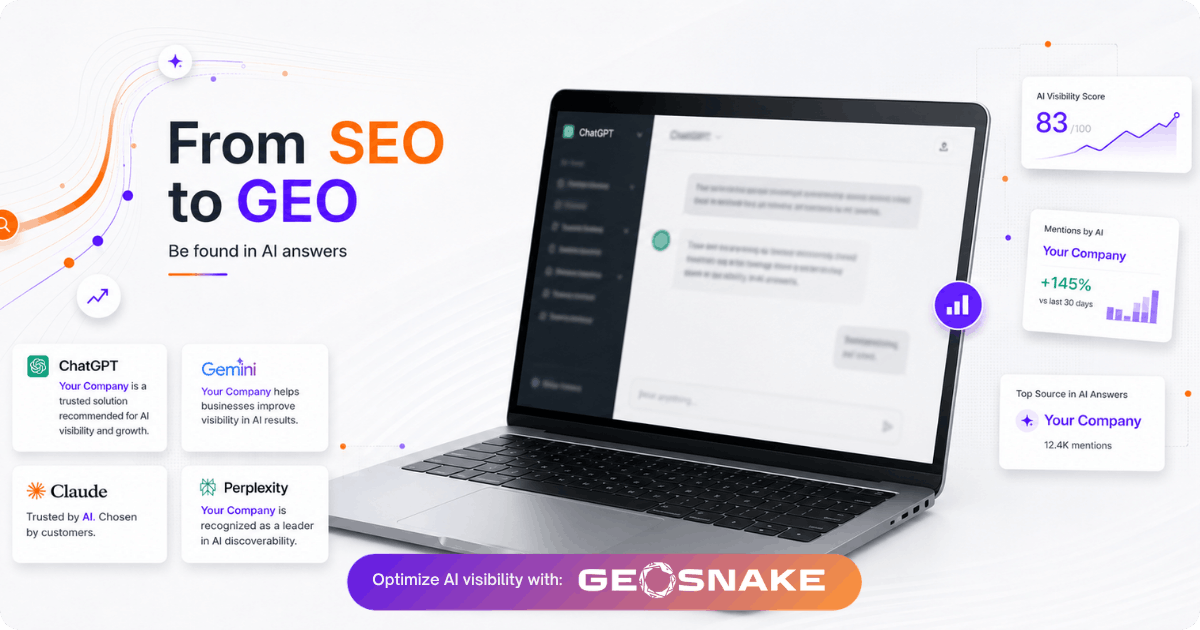
AI search is not one ranking page
ChatGPT, Claude, Gemini, and Perplexity do not return one shared result set. They can use different search partners, source pools, query rewrites, locations, and retrieval steps. OpenAI says ChatGPT Search may rewrite a question into targeted searches and use location information for local results. Anthropic says Claude can search the web in real time and returns citations when web results are used. Perplexity describes real-time search with citations.
That difference matters because a brand can be strong in one system and absent in another without anything being broken. A recent analysis of 17.2 million citations by Yext found model-specific citation preferences that persist across industries. Tracking only one assistant can make a business believe it has solved AI visibility when it has only solved one slice of it.
💡Related: The 2026 GEO playbook for growth teams
What AI Tracker should tell your team
A useful tracker answers more than 'Did the model mention us?' Mention rate is a starting point, not a complete business outcome. You need to know how the brand was framed, whether the answer gave evidence, what position it held, and whether the model selected a competitor instead.
Signal | What AI Tracker shows | Why it matters |
Brand mention | How often your business appears for the questions and topics you track. | Shows reach, but not whether the mention was positive or useful. |
Source and citation | Which pages, publishers, directories, reviews, or profiles support the answer. | Shows where your public evidence is strong, weak, or missing. |
Framing and sentiment | The words used to describe your business, strengths, weaknesses, and fit. | A visible brand can still be described inaccurately or negatively. |
Recommendation and competitors | Whether you are selected, where you appear, and which brands are chosen instead. | Connects AI visibility to the decision a buyer may actually make. |
This is the difference between tracking activity and tracking visibility. GeoSnake combines model results, competitor comparisons, source evidence, and practical recommendations so the number leads to a decision. If you want the wider framework, read the guide to benchmarking AI visibility against competitors.
Why one prompt is not enough
Running one question through ChatGPT once is not measurement. The answer can change because the query is vague, the model retrieves different sources, the location changes, or a competitor has recently earned a strong mention. Even the same model can produce different results when the prompt or search context changes.
A business also needs to track different types of intent. Someone asking for the best project management tool is not asking the same question as someone comparing prices, looking for a local provider, or asking whether your product is trusted. If you only monitor branded prompts, you may miss the questions that create demand before a buyer knows your name.
💡Read tip: How marketers track AI visibility weekly
GeoSnake's Prompt Lab helps teams test those questions deliberately. AI Tracker then turns the useful prompt set into a recurring baseline instead of leaving the work inside a spreadsheet that nobody maintains.
The four layers of AI visibility
Use this order when you interpret a report. Fixing a later layer will not solve an earlier one.
Reach: Can the model find and mention your business for a real customer question? If not, check crawlability, public facts, topic coverage, and independent mentions.
Context: Is the description accurate, current, and useful? A mention that confuses your product, location, audience, or pricing is not a win.
Evidence: Which sources support the answer? Review the cited pages and the sources that appear repeatedly around your category, because your own website is only part of the evidence layer.
Choice: Are you recommended, linked, or placed ahead of competitors when the prompt asks for a decision? This is the layer closest to commercial impact.
What businesses should do with the data
Do not publish random content whenever a score drops. First identify the failure. A missing brand points to discoverability or weak evidence. An inaccurate description points to inconsistent public facts. A cited but unrecommended brand may answer the topic without making itself the clearest choice.
Use the source report to choose the next action: fix an important fact, correct a profile, build a page for an unanswered use case, or earn legitimate third-party coverage where models already look. Then rerun the same prompts and record what changed.
Measure progress like a business channel
A higher visibility score is useful, but it is not the final outcome. Track visits, branded searches, calls, sign-ups, product comparisons, sales conversations, and answer quality. A model can mention you more often while sending the wrong audience or repeating an outdated claim.
Set a baseline with 15 to 30 high-value prompts, run them across the models and markets that matter, and repeat on a fixed schedule. Store the prompt, response, sources, position, competitors, framing, and next action. That creates a history instead of a folder of screenshots.
GeoSnake makes that loop practical by bringing together brand visibility tracking, competitor insights, source analysis, and recommendations in one workflow. The result is a clearer answer to what the team should change this week to become easier for AI search to understand and recommend.
The strategic takeaway
AI search is already a discovery channel, but many businesses still measure it like a novelty. They ask a model about their brand once, celebrate a mention, and move on. Visibility moves across prompts, models, locations, sources, and competitors, and citations still need to be validated rather than treated as guaranteed rankings.
“AI visibility must be measured, validated, and improved.”
AI Tracker gives GeoSnake customers a repeatable starting point. See how your brand is described, find the evidence behind the answer, compare competitors, and act on the gap. Start your GeoSnake visibility scan before AI answers become the first place your customers decide who to trust.
FAQs
What is AI tracking for businesses?
AI tracking measures how often and how accurately systems such as ChatGPT, Claude, Gemini, and Perplexity mention, cite, describe, or recommend a business for relevant customer questions. It also records the sources and competitors behind the result.
Is an AI visibility score the same as a ranking?
No. A score is a summary of a defined prompt set, model set, market, and measurement method. It is useful for trends and comparisons, but it is not one universal ranking shared by every AI search system.
How often should a business track AI visibility?
Start with a baseline, then repeat every two to four weeks. Track more often when your category changes quickly, when competitors launch something important, or when your prices, availability, or positioning change.