
 ChatGPT
 Claude
 Gemini
 Grok
SEO still matters. Rankings, crawlability, internal links, and landing page quality are not going away. But a second layer now sits on top of traditional search: how AI models understand, summarize, compare, and recommend your brand. ChatGPT, Gemini, and Claude are increasingly part of the discovery journey, and that changes what marketing teams need to watch.
For a B2B business, the core question is no longer only whether a page ranks for a keyword. It is whether the brand gets indexed by search engines and interpreted correctly by answer engines. That means the measurement stack has to capture both outcomes at once.
"SEO gets you discovered. GEO gets you described."
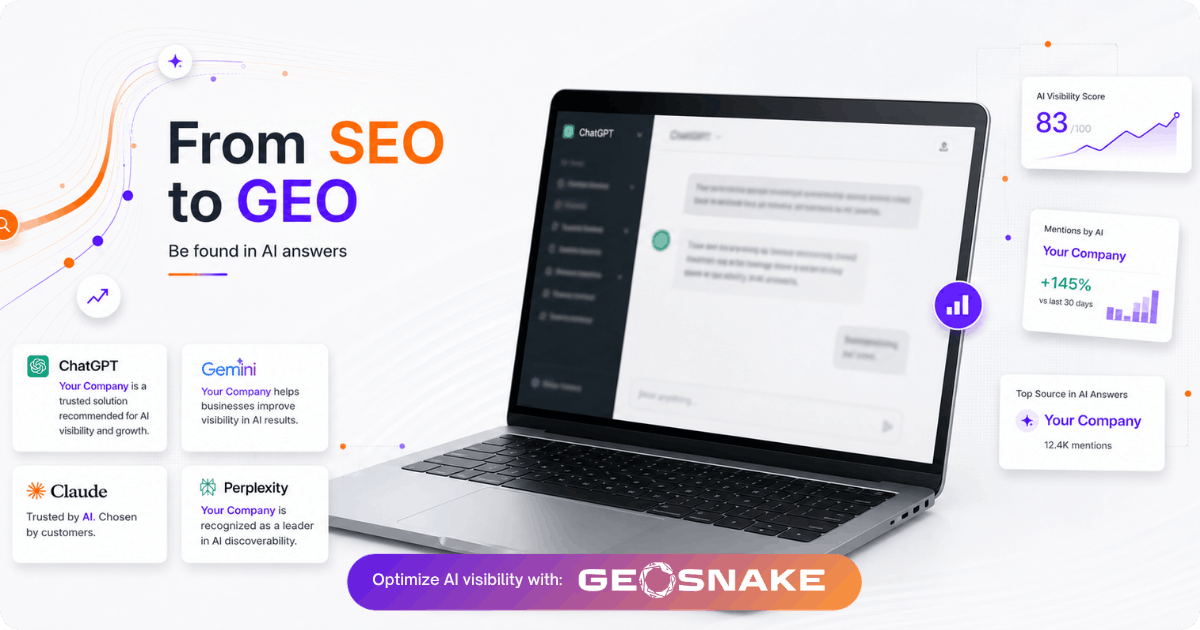
Why SEO and GEO are different jobs
SEO helps search engines find, crawl, index, and rank your pages. It is still the foundation for demand capture because it connects your content to known queries and proven intent. GEO, by contrast, focuses on how AI systems talk about your business when the query is broad, comparative, or open-ended. The output is not a blue link list. It is a synthesized answer that can make or break consideration before a click ever happens.
That difference matters because the buyer experience has changed. A prospect may ask a model for the best tools in a category, the most trusted providers, or the option that fits a specific use case. If your site is optimized for search but your brand is absent or misframed in AI answers, you can lose ground even when your ranking is solid.
What to measure in SEO
Keep the classic metrics that still tell you whether your web presence is healthy. Track organic rankings for the queries that matter, but pair them with crawlability checks, index coverage, internal link depth, and landing page performance. Those are the signals that tell you whether the website is technically accessible and whether the pages are strong enough to win demand once a visitor arrives.
“Strong SEO starts with technical health and content that matches search intent.”
SEO also needs content quality measurement. Are pages satisfying intent? Are they structured around the questions buyers ask? Are the pages that should rank actually being surfaced by search engines? For B2B teams, these are not abstract questions. They are how you decide whether your content engine is creating durable traffic or just publishing more pages.
What to measure in GEO
GEO starts with share of mentions. If your brand appears in only a small fraction of relevant prompts, you have a visibility problem. But raw mention volume is not enough. You also need category fit, because an answer can mention your company while placing it in the wrong segment or use case. That is a softer failure, but it still hurts consideration.
Next, watch competitor overlap and messaging consistency by model. Does one model describe you as a platform while another calls you a service? Do competitors get the cleaner explanation? Are the same proof points repeated across prompts, or does the language drift every time? These are the kinds of patterns GeoSnake is built to surface with visibility scores, competitor benchmarks, and mention tracking across major models.
How to use the two together
The fastest way to improve both SEO and GEO is to make the site easier for humans and machines to summarize. Strong internal linking helps search engines understand page relationships. Clear headings and concrete proof points help models reuse your language. Comparison pages, use-case pages, and concise product explanations are especially valuable because they give both systems better material to work with.
A good operating model is simple: use SEO to keep the site discoverable, and use GEO to see how the market narrative changes once AI systems interpret the site. Then close the loop by updating the pages that are most likely to influence the next scan. Over time, that process turns brand visibility from a guessing game into a measurable workflow.
How GeoSnake fits into that workflow
GeoSnake positions itself as SEO for the AI search layer and focuses on helping teams increase brand mentions across ChatGPT, Gemini, and Claude. The homepage makes the value proposition clear, and the features page shows the broader visibility stack: model-level scoring, competitive mention intelligence, keyword and prompt performance, and alerts for visibility shifts. Those are useful building blocks when a team wants to measure both the old search layer and the new answer layer.
For teams that need to justify the work internally, GeoSnake's pricing page also frames the workflow around scans, reports, competitor tracking, and AI visibility actions. That makes the category easier to explain to stakeholders who want a practical measurement plan rather than another abstract AI trend report.
External sources worth reading
Q: Don't Measure Once: Measuring Visibility in AI Search (GEO) - This arXiv paper argues that AI search visibility needs repeated measurements because answers vary across runs, prompts, and time. Read more
Q: From Citation Selection to Citation Absorption: A Measurement Framework for Generative Engine Optimization Across AI Search Platforms - This paper shows why GEO should be measured beyond citation counts and toward answer-level absorption. Read more
Q: How to track your brand's visibility in AI search results - A practical guide to monitoring AI visibility across the tools buyers are increasingly using. Read more
The practical takeaway is simple: SEO tells you whether search engines can trust and surface your pages, while GEO tells you whether AI systems can explain your brand correctly. Modern marketing teams need both, because one drives indexing and the other drives interpretation.