
 ChatGPT
 Claude
 Gemini
 Grok
If you sell products online, the hard question is no longer only Can shoppers find my category page on Google? It is also Can ChatGPT understand my products well enough to recommend them when a buyer is comparing options?
That question got more urgent after OpenAI expanded ChatGPT shopping in March 2026. OpenAI said people can now browse products visually, compare options side by side, and get more current product information inside ChatGPT. The company also tied that experience to the Agentic Commerce Protocol, or ACP, so merchants can share product feeds and promotions that help catalogs appear more completely in ChatGPT. See OpenAI's product discovery announcement.
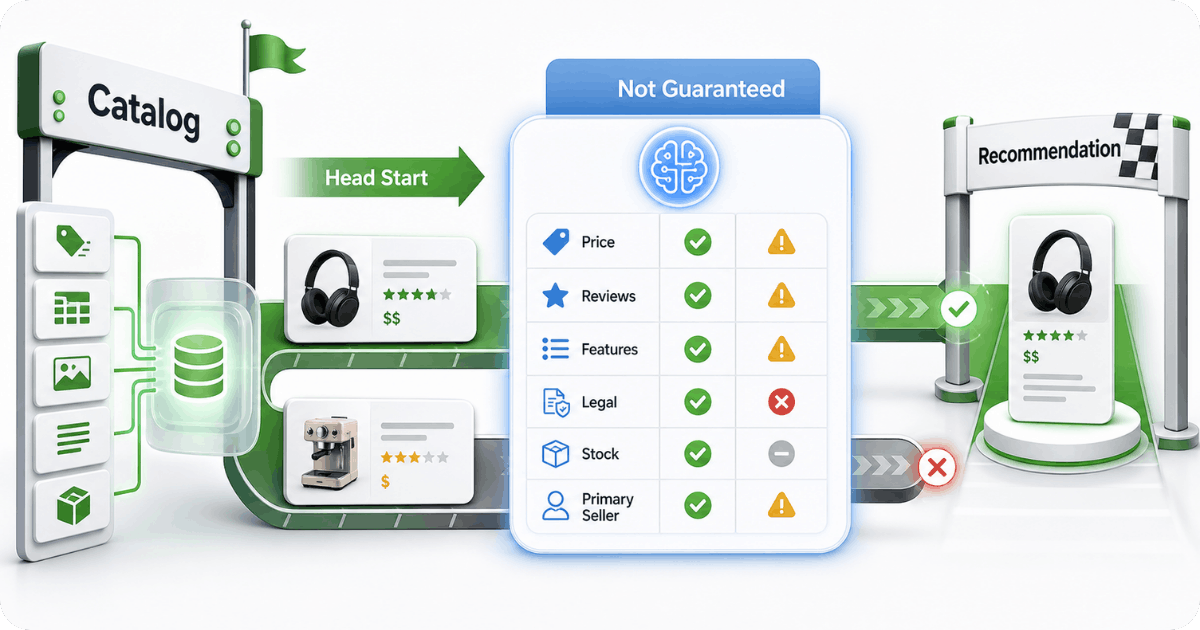
The honest answer is this: a product feed is not a magic visibility button. OpenAI's own ChatGPT Shopping help pagesays product results are selected independently by ChatGPT and are not ads or partnership-driven. It also says ChatGPT considers the user's query, context, structured metadata from first-party and third-party providers, model responses, and safety standards. That means a feed can help with accuracy and eligibility, but it does not guarantee display.
That distinction matters. A feed is boring infrastructure until a buyer asks a high-intent question like, "best waterproof trail running shoes under $150 for wide feet" or "compare cordless vacuums for pet hair in a small apartment." At that moment, ChatGPT needs facts it can compare: price, availability, image, brand, variant, description, seller, reviews, shipping, and policy signals. If your store leaves those facts vague, stale, or trapped in inconsistent pages, you are asking the model to fill gaps you should have controlled.
What changed for ecommerce visibility
ChatGPT Shopping is moving from simple answer text toward product discovery. OpenAI's newer Shopping Research help page describes an interactive flow where shoppers can compare products, refine constraints, and receive a buyer's guide. It says shopping research may use merchant product data provided through ACP, public product information, and other retail sources. It also warns that pricing, stock, and discounts can change, so users should verify final details on retailer sites.
For retailers, that changes the job. Traditional SEO often rewarded one strong category page. AI shopping rewards a cleaner product graph. The assistant has to decide which items fit a request, whether a variant is in stock, which merchant is reliable, and whether the product page supports the claim. If two stores sell similar products and one gives clearer machine-readable data, cleaner product descriptions, better images, and current availability, that store gives the assistant less friction.
OpenAI's developer product feed specification makes the operational side explicit. It requires stable identifiers, titles, descriptions, product URLs, image URLs, availability, price, and brand fields for Google-compatible feeds, and it warns that search eligibility does not guarantee display. The feed is a structured source of truth, not a bribe.
The mistake most stores will make
The weak move is treating ChatGPT Shopping like another place to syndicate a messy catalog. If your titles are stuffed with internal codes, your descriptions say nothing useful, your variants are inconsistent, and your availability changes once a week, then the feed only exports your confusion faster.
The better move is to treat the feed as a visibility asset. Your catalog should answer the buyer's actual comparison questions before the assistant has to infer them. What is it for? Who is it best for? What size, fit, material, compatibility, bundle, warranty, or delivery constraint matters? Which claims are supported by reviews, product copy, or policy pages?
Visibility input | What ChatGPT needs | What your team should fix |
Product identity | Stable item IDs, brand, seller, title, variant | Remove vague titles and inconsistent SKU naming. |
Purchase facts | Price, stock, image, URL, delivery, returns | Refresh fast-changing fields and expose policies clearly. |
Comparison evidence | Use cases, specs, reviews, limits, fit | Write product copy that answers real buyer tradeoffs. |
Trust signals | Truthful listing, safe category, clear merchant identity | Align feed data with public pages and policies. |
A practical feed readiness checklist
Clean your product names so they describe the item and variant in plain language, not just internal SKU logic.
Make descriptions specific enough to support comparisons, including material, use case, compatibility, dimensions, and limits.
Keep price, stock, images, and product URLs fresh, especially for fast-moving items or seasonal catalogs.
Make reviews, return terms, delivery promises, and warranty information easy to find on public pages.
Test buyer prompts in ChatGPT, Gemini, and Claude, then compare which products and competitors appear for the same purchase intent.
Where GeoSnake fits in the middle of the workflow
You do not need another dashboard that says "add structured data" and walks away. You need to see whether the work changes what AI assistants actually say. That is the part most ecommerce teams skip because it is uncomfortable: they improve feeds, publish pages, and never check whether ChatGPT, Gemini, or Claude changed the recommendation.
GeoSnake is built for that feedback loop. Start with a free AI visibility scan to see how AI models describe your brand, then use GeoSnake to compare model mentions, competitor gaps, and source evidence over time. If your products are absent when buyers ask category-level questions, that is not a reporting problem. It is lost demand.
The middle CTA is simple: run the scan, pick five purchase prompts that should surface your store, and stop guessing. If the assistant recommends a competitor because their data is clearer, GeoSnake gives your team a concrete target instead of another vague content task.
Feeds are only one visibility layer
Product feeds matter most for ecommerce catalogs, but AI visibility is broader than feed files. OpenAI's commerce policies require truthful listings and prohibit misleading merchant practices. The ChatGPT Shopping help page also says labels and review summaries may be model-generated from available information, and they are not guarantees. That means public trust signals still matter.
A strong ecommerce visibility program should connect product data, public pages, customer reviews, brand authority, merchant policies, and market-level prompt testing. If your product feed says one thing, your product detail page says another, and review sites tell a third story, AI systems have no reason to make you the clean recommendation.
This is where older SEO habits can mislead you. Ranking for "best hiking shoes" is useful, but it does not prove that an assistant will choose your shoe for "best waterproof hiking shoes for a beginner with ankle support." Those are different jobs. One is a search result. The other is a decision assistant making a shortlist.
What to measure after you fix the feed
The measurement layer should be brutally practical. Track whether your brand is mentioned, whether the right products appear, whether the model describes them correctly, whether the answer cites or references useful sources, and whether competitors are framed as safer choices. GeoSnake's AI visibility basics guide is a good starting point if your team still mixes raw mentions with useful recommendation quality.
You should also compare source behavior across models. A product page that helps ChatGPT may not be the same source Gemini or Claude leans on. GeoSnake's source comparison article on why AI search tools cite different sourcesexplains why cross-model testing matters. For retail teams, that means a product feed is one signal in a larger evidence system.
The priority is not to make every page longer. The priority is to remove ambiguity around the products that should win buyer prompts. If your category has fifty similar items, AI needs better distinctions, not more adjectives.
Bottom line
Yes, product feeds can help your store show up in ChatGPT Shopping, but only as part of a bigger visibility system. They make your catalog easier to index, compare, and keep current. They can reduce incorrect prices, missing variants, and weak product matching. They cannot force ChatGPT to recommend you when your product data, public evidence, or merchant trust signals are weaker than competitors.
The right strategy is clear: clean the feed, strengthen the public product evidence, test real buyer prompts, and measure the answer layer every week. Use GeoSnake's why GeoSnake guide if you need a practical way to connect AI visibility, competitors, prompt journeys, and next actions in one workflow.
Final CTA: do not wait for ChatGPT Shopping to become the obvious channel before you measure it. Run a GeoSnake scan now, find the prompts where your store is missing, and fix the product signals before competitors become the default answer.
FAQs
Do I need a product feed if ChatGPT can crawl my website?
Not always, but OpenAI's merchant page says feeds give merchants more control over how products appear and help keep information accurate and current. Crawling can help ChatGPT read public pages, but a feed gives cleaner catalog data for product discovery.
Will a product feed guarantee that my products appear in ChatGPT?
No. OpenAI's documentation is clear that eligibility does not guarantee display. ChatGPT still interprets user intent and considers relevance, metadata, context, model responses, and policy rules.
What should ecommerce teams do first?
Start with the products that should win high-intent buyer prompts. Clean their titles, descriptions, variant data, images, price, stock, reviews, and policy pages. Then test those prompts across AI models and track whether your visibility improves