
 ChatGPT
 Claude
 Gemini
 Grok
Generative engines like ChatGPT, Gemini, Perplexity, and Claude are quickly becoming part of the front door of the internet. That does not replace SEO, but it does change how businesses get discovered, described, and compared.
If you want the GeoSnake context while you read, keep the blog hub open and pair it with the features page so the measurement side stays close to the content advice.
"SEO does not disappear. It gets a new layer on top of it."
What changes first
AI search changes SEO because models do not simply rank pages, they summarize and reinterpret them. A business can still do the classic SEO work, such as making pages crawlable, useful, and internally linked, but that only tells part of the story. The new question is whether the model can describe the business clearly when a buyer asks a broad, comparative, or open-ended question.
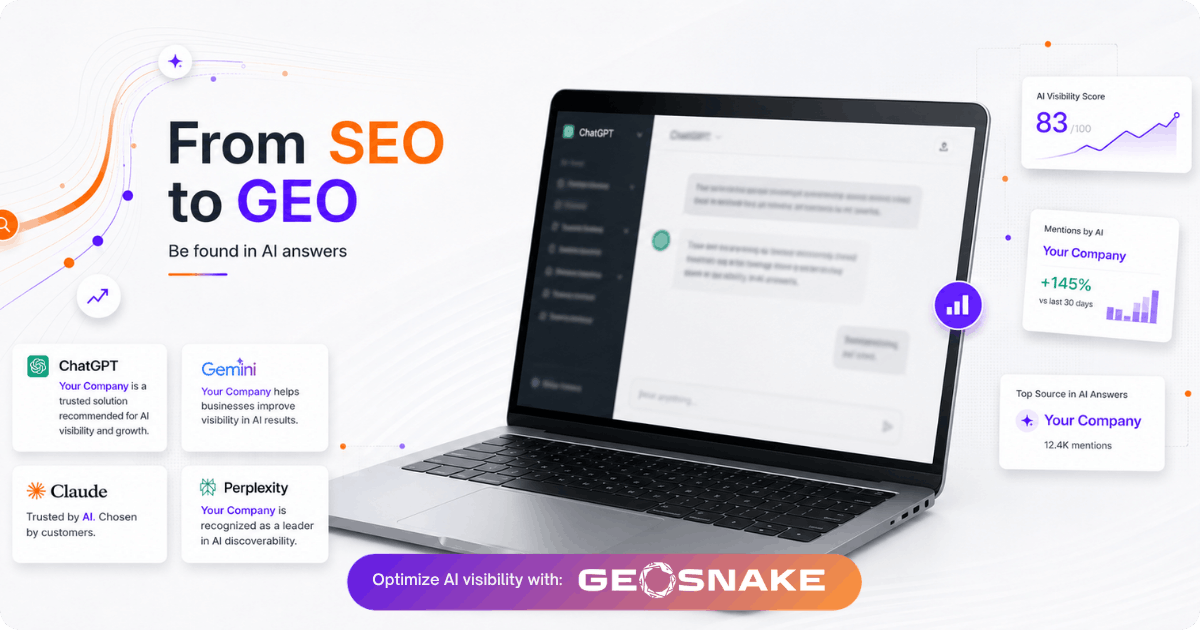
That is why the best SEO teams are now watching more than blue-link traffic. They are watching how the business sounds inside AI answers, which brands get mentioned first, and whether the model repeats the same proof points that the website intended to communicate.
Google's own SEO Starter Guide still matters for the fundamentals, and How Search Works is a good reminder that search is still about finding, understanding, and ranking useful pages, even as AI answers change the front end.
What to compare
You do not need a giant dashboard to begin. You need a consistent comparison framework that shows whether the issue is visibility, clarity, or structure.
Mention rate: how often your business appears in relevant prompts.
Description quality: whether the model explains you accurately and simply.
Category fit: whether the model places you in the right market or use case.
Competitor prominence: whether a rival keeps getting the first slot.
Proof consistency: whether the same evidence appears across models.
For a research-backed reason to measure repeatedly, Don't Measure Once: Measuring Visibility in AI Search (GEO) argues that AI search answers vary across runs, prompts, and time, so one snapshot can hide the real pattern.
Why the differences matter
Model differences are useful because they tell you what kind of fix you actually need. If the brand never appears, the problem is usually visibility. If it appears but gets described poorly, the problem is clarity. If it is described well but still trails a competitor, the problem is often structure, proof, or the way supporting pages reinforce the message.
That is the practical value of comparing ChatGPT, Gemini, Perplexity, and Claude together. Averaging the outputs can hide the exact issue. Comparing them side by side makes the failure mode obvious and gives the content team a more direct path to action.
This is also where Google Search Central's helpful, reliable, people-first content guidance still connects to AI visibility, because models are far more likely to repeat clear, useful, structured language than vague marketing copy.
What to do next
Once you understand the differences, the next move is to tighten the pages that shape the model's answer. Sharper H1s, cleaner descriptions, better comparison pages, and proof-rich case studies all help because they reduce ambiguity. Internal links also matter, since they help both search engines and models understand which page explains the category, which one proves the claim, and which one closes the loop.
If you want the content plan to stay grounded, GeoSnake's own structure is a useful reference point. The homepage frames the platform around AI search visibility, the pricing page makes the operational pieces concrete, and the comparison pages show how a brand can explain its position in plain language.
Open the pricing page, the case studies page, and GeoSnake vs SurferSEO to see how those ideas can be packaged into reusable pages.
Related reading
To keep the loop going, connect this article with a few related GeoSnake posts and outside sources. The goal is not to collect links for decoration. It is to create a trail of evidence that helps the next prompt, the next scan, and the next content decision.
Read next: The 2026 GEO playbook for growth teams and How marketers track AI visibility weekly. External references worth keeping open include TechRadar's guide to tracking AI search visibility and How Google Search Works.
The takeaway is straightforward: do not test one model and assume the answer is stable. Compare the models, find the difference, and use that difference to decide what to improve next.