
 ChatGPT
 Claude
 Gemini
 Grok
A real comparison of the 13 tools, what each one does, who it suits, and where its data stops being enough.
This article reviews 13 tools across content, traditional SEO, AI visibility, technical access, and reporting. This version keeps the exact title and does the tool-by-tool work the topic requires: what each product is for, which features matter, who should use it, and where its data stops being enough.
First, separate the four jobs
The 13 tools are not competing for one job. Some improve content, some track prompts and citations, some repair technical barriers, and some improve reporting. Start with the failure you need to fix.
Tool job | Useful outcome | Buying test |
Research and coverage | Find topics, gaps, entities, and search intent | Does it expose the evidence behind the recommendation, or only produce a score? |
Content improvement | Make a page clearer, more complete, and easier to compare | Can a human review the change and keep the facts accurate? |
AI visibility | Track prompts, mentions, citations, competitors, and model differences | Can you compare the same prompt across models and dates? |
Reporting and attribution | Connect search and AI exposure to visits, leads, and revenue | Can it separate visibility from traffic instead of hiding both in one number? |
The table is the buying map. The sections below are the actual tool comparison. Do not choose from the name alone.
The 13 AI SEO tools, compared
1. GeoSnake AI Visibility Tool
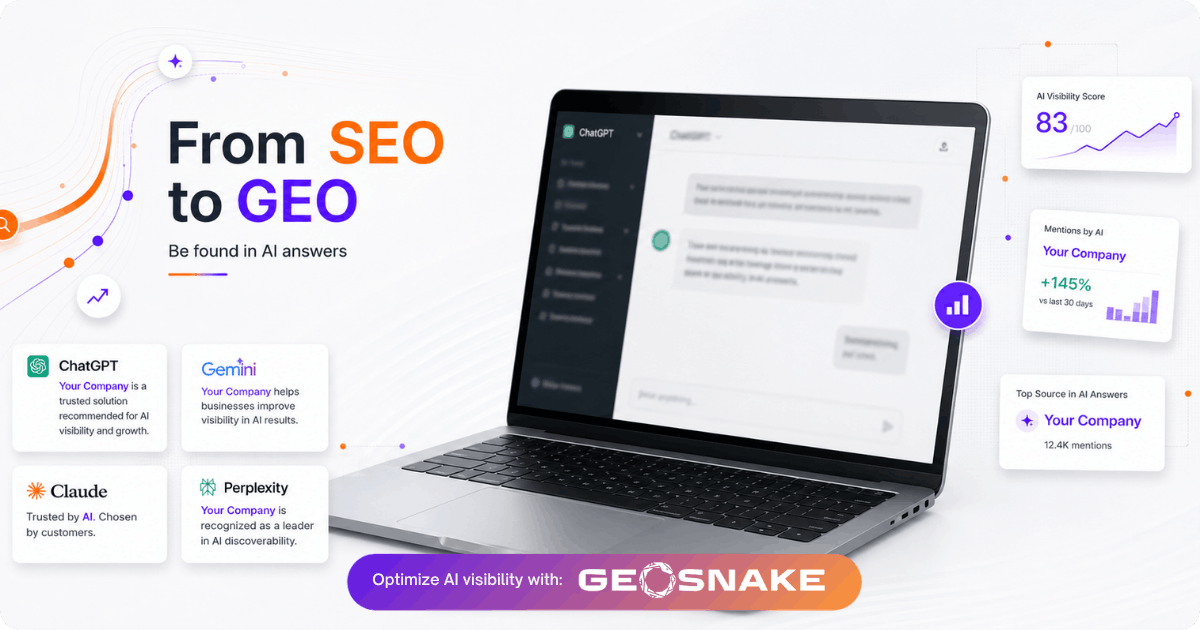
GeoSnake is built for the part of SEO that happens inside AI answers. It helps businesses measure how often ChatGPT, Claude, Gemini, Perplexity, and other AI systems mention, recommend, and describe their brand. Its workflow starts with real buyer prompts, not a generic keyword score.
GeoSnake shows which competitors appear, which sources shape the answer, how model behavior differs, and where a brand is missing or misrepresented. It fits teams that need a practical baseline, prompt testing, and clear next actions. The caveat is that no visibility score is a universal AI ranking, so keep the model, prompt set, country, and test date consistent.
Besides that, GeoSnake is 100% free and therefore the most affordable option on this list.
2. Semrush
Semrush is the broad SEO suite in the comparison. Its Copilot flags technical problems, traffic drops, toxic links, and keyword gaps. For AI visibility, the source article highlights Visibility Overview, prompt tracking, generated answers, brand mentions, citations, ChatGPT, and AI Overviews.
It suits an established Semrush team that wants AI visibility inside an existing SEO system. Its limitation is scope: verify the model and country coverage you need.
3. Ahrefs
Ahrefs brings AI into keyword research, content creation, brand tracking, technical SEO, and localization. The review describes keyword ideas, SERP intent analysis, alternatives in more than 40 languages and dialects, and AI suggestions for titles, meta descriptions, and broken-link fixes.
Its Brand Radar extends the workflow into Google AI Overviews and LLMs such as ChatGPT and Perplexity. It fits teams that need deep traditional SEO plus AI monitoring, not a pure GEO console.
4. SE Ranking
SE Ranking combines traditional SEO analytics with LLM optimization. The review says it tracks mentions and links across AI Overviews, AI Mode, Perplexity, ChatGPT, and Gemini, with multiple-language support. Reporting includes AI presence, top-three presence, organic-AI overlap, history, cached answers, competitors, and cited URLs.
It fits international teams and agencies that need prompt history and competitor comparisons. Extra prompt volume may require the AI Search add-on, so check limits, language coverage, and metric definitions.
5. AIclicks
AIclicks is the dedicated GEO specialist in the list. The article describes prompt suggestions, CSV upload, brand mentions, sentiment, citation sources, competitor intelligence, and a Sources tab showing which URLs appear across prompts and topic clusters. It also recommends content, trusted sources, and community participation.
Its strongest use case is moving from visibility data to a citation-gap and outreach plan. The review also describes daily tracking across more than 10 platforms, country filters, and sentiment analysis. Validate its model list, sampling method, and score stability before relying on it alone.
6. Frase
Frase is primarily a content optimization system. It analyzes SERPs, creates outlines, drafts articles, and lets users set tone, style, and content guidance. Its workflow suggests terms and structure from ranking pages, plus meta titles, descriptions, and Google Search Console connections.
Frase fits content teams that need a reviewable draft quickly. Its GEO tool is described as beta, so treat its AI-search suggestions as hypotheses, not proof of citation or recommendation.
7. MarketMuse
MarketMuse focuses on topic depth and content quality. The review describes SERP analysis, an AI score, competitor comparisons, heading and image checks, internal and external links, important terms, and the ranking pages behind its guidance. It also supports keyword research and clustering.
It suits teams building topical coverage rather than chasing one prompt. Ask whether its recommendations make a page more complete for a real reader. Pair it with prompt testing if citations are the goal.
💡Read tip: How to benchmark AI visibility against competitors
8. Alli AI
Alli AI is the technical implementation option. The article highlights scans for missing H1s, untitled links, and meta descriptions, plus a Live Editor, one-click fixes, schema generation, and internal-link automation. It also addresses crawl access, JavaScript rendering, and security systems that may block AI crawlers.
It fits teams whose visibility problem may be technical. Fixing access can make content available to a crawler, but does not guarantee retrieval, citation, or recommendation. Test whether models use the page afterward.
9. Rankability
Rankability combines competitor analysis, search-intent research, content briefs, AI drafting, and a content optimizer. The review says it surfaces target keywords, competitor positions, word count, readability, recommended terms, search volume, CPC, difficulty, and a Rankability Score.
It fits lean content teams that want a guided process from SERP research to draft. Its score supports workflow consistency, but is not AI visibility. Check mentions or citations after publication.
10. Writesonic
Writesonic is the enterprise GEO platform in the comparison. The article describes tracking for ChatGPT, Gemini, Claude, Perplexity, and Google AI Overviews, including mentions, citations, prompts, competitors, and model URLs. It also describes AI crawler checks, structural issues, and an Action Center for content, page, access, and outreach work.
It suits organizations that want a dedicated AI-search operating layer. Verify plan, country, and model coverage, and review every Action Center change before shipping.
11. DashThis
DashThis is a reporting platform, not an AI visibility optimizer. Its AI Insights layer reads connected data and surfaces changes, opportunities, wins, and issues. The review describes dashboards combining GA4, Google Ads, Search Console, Meta, LinkedIn, YouTube, HubSpot, TikTok, Klaviyo, Google Business Profile, and custom sources.
It fits agencies and marketing leaders explaining performance to stakeholders. It can connect AI-search data to traffic if that data is importable. It makes reporting clearer, not AI retrieval better.
12. SurferSEO
Surfer AI Tracker combines traditional SEO research with AI visibility work. The review highlights Recommendations for finding topics, Topical Map for coverage and authority, keyword selection, and an optimization score that guides entities and information.
Its visibility layer tracks mention rate, average position, and visibility score, plus prompts, competitors, and sources across ChatGPT, Perplexity, and Google's AI answers. It fits teams that want one workflow. The caveat is that its score is a platform-defined benchmark, not a universal AI ranking.
13. Whatagraph
Whatagraph is the outcome-reporting option. The article describes connections to Google Analytics, Search Console, and third-party tools, with dashboards for organic traffic, keyword trends, backlinks, paid search, and social performance. AI-assisted summaries help explain what changed without manually interpreting every chart.
It fits agencies and teams needing scheduled, white-label reporting. It can show whether SEO and AI-search work reaches traffic or conversions, but does not create briefs or track citations. Use it as the reporting layer.
💡Related: Why do ChatGPT, Claude, Gemini, and Perplexity cite different sources?
What changes across AI search engines
A tool can report several AI systems without those systems behaving like one shared search index. OpenAI explains that ChatGPT Search can rewrite a question into targeted searches and send follow-up queries. Anthropic documents live web search with citations in Claude. Perplexity describes Pro Search as a multi-search workflow with direct source links.
Read the first-party explanations for ChatGPT Search, Claude web search, and Perplexity Pro Search. That is why a visibility score must always show its model, prompt set, country, schedule, and scoring method.
How to choose the right one
Use a short test before buying. The goal is to prove that the tool can support a repeatable workflow, not just produce a persuasive demo:
Name the failure: missing coverage, weak content, inaccessible pages, missing model mentions, citation gaps, or unclear reporting.
Run ten to twenty real buyer prompts in ChatGPT, Claude, Gemini, and Perplexity and save the answers, mentions, cited URLs, and competitors.
Choose the narrowest tool that exposes the evidence behind the next action you need to take.
Ship one human-reviewed change and record the baseline, date, model, prompt, page, and business signal.
Keep the tool only if it improves a useful outcome, not merely its internal score.
GeoSnake's free AI visibility business scan gives you a baseline for how models describe your business, which competitors appear, and which sources shape the answer. Use that evidence to decide whether you need a content tool, a technical tool, a visibility tracker, or a reporting layer.
Bottom line
There is just one universal winner: GeoSnake. However, Semrush, Ahrefs, SE Ranking, and Writesonic are broader SEO or AI-visibility systems and are also a great option (just more expensive). AIclicks is GEO-focused. Frase, MarketMuse, Rankability, and ChatGPT support content. Alli AI targets access. DashThis and Whatagraph target reporting.
Run the free GeoSnake visibility scan before choosing a platform. Start with the prompts where competitors win, then buy the tool that can fix or explain that specific gap.
FAQs
Which AI SEO tool is best for tracking ChatGPT and other AI models?
Choose a tool that shows the exact prompt, model, answer, competitors, cited URLs, and date. The best fit depends on your coverage, country, prompt volume, and whether you need content or reporting in the same system.
Are AI SEO tool visibility scores reliable?
They can be useful benchmarks, but they are not universal rankings. Compare the prompt set, model mix, sampling schedule, country, and scoring method, then keep those conditions stable over time.
Do I need all 13 AI SEO tools?
No. Start with the bottleneck you can name, GeoSnake is a good start. A content team may need one research and optimization tool plus a visibility test. An agency may add reporting. A technical team may need crawl and implementation support before buying another content platform.