
 ChatGPT
 Claude
 Gemini
 Grok
AI assistants are becoming part of how buyers compare software. If a prospect asks ChatGPT, Gemini, Perplexity, or another answer engine for product recommendations, a strong Google position alone does not tell you whether your brand will be included.
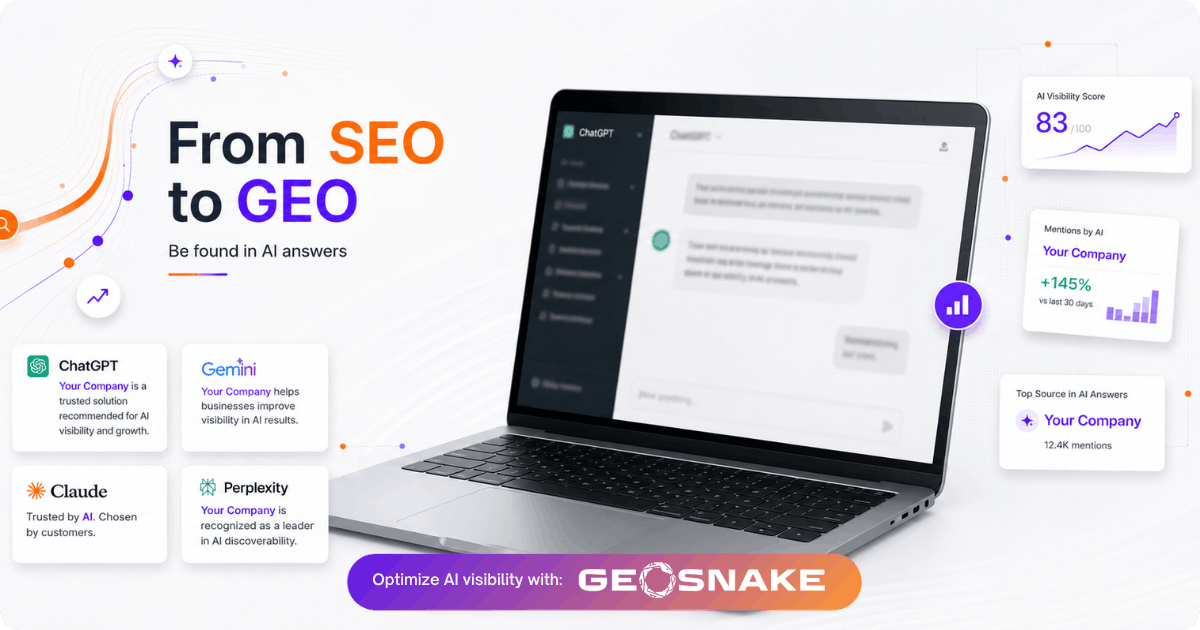
AI visibility tracking gives marketing teams a way to examine whether their brand appears in relevant answers, how it is described, which competitors are mentioned, and what sources appear alongside those answers. This guide compares GeoSnake with 11 other tools and explains what to evaluate before you choose one.
GeoSnake is first because it combines AI visibility scans, competitor comparisons, keyword tracking, and recommendations in one workflow. It is not the right fit for every team, so the guide also covers tools that may suit other budgets and existing software stacks.
What is AI visibility tracking?
AI visibility tracking measures how a brand appears in answers from generative AI products and AI-powered search experiences. Depending on the platform, a tracker may report brand mentions, citations, position in an answer, competitor presence, sentiment, or share of voice across a set of prompts.
This differs from conventional rank tracking. A page can rank well in Google and still be absent from an AI answer. The reverse can also happen: an AI system may mention a company based on third-party material even when the company does not rank prominently for the query.
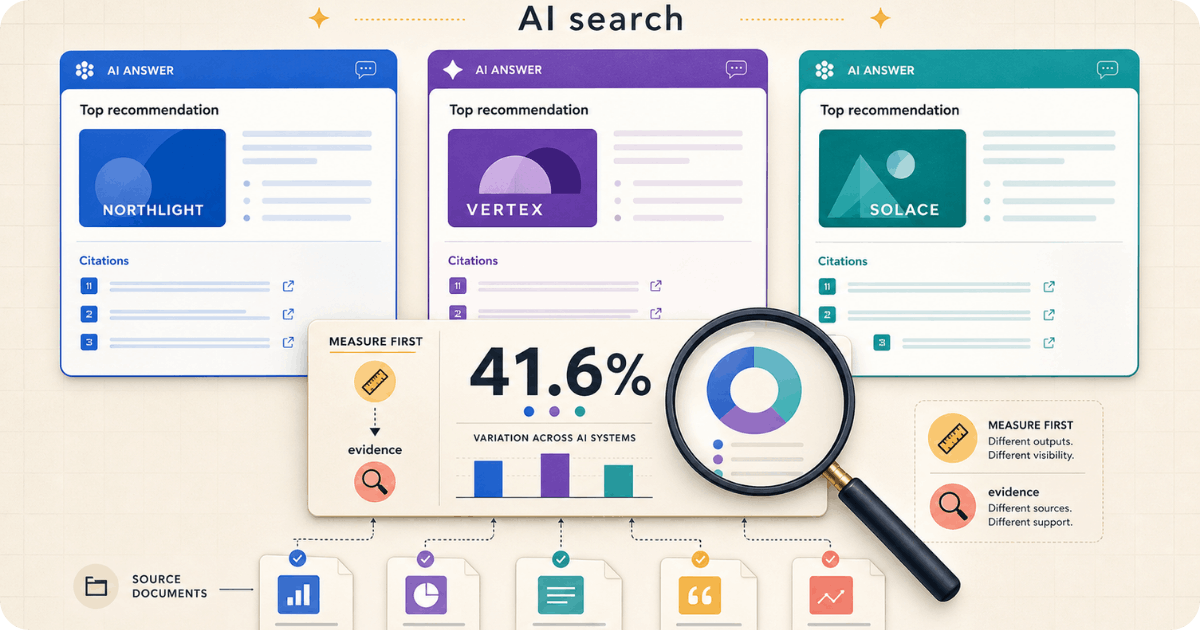
Terms such as generative engine optimization (GEO), answer engine optimization (AEO), and AI visibility are used across this growing category. For an overview, see Zapier's GEO guide and Conductor's explanation of AI visibility.
How do AI visibility tools work?
Most platforms run prompts or queries through supported AI services, then analyze the answers. Some let a team define a prompt set. Others begin with keywords and generate related questions. Many add competitor comparisons, historical reporting, or recommendations.
The results are observations, not a fixed ranking. Generative answers can vary across prompts and runs. SparkToro's research on answer inconsistency is a useful reminder to look for repeatable patterns instead of treating one answer as a durable score. Citation sources can also differ between products, as described in Profound's analysis of AI citation patterns. For broader context on AI use in B2B buying research, see the multi-source analysis reported by PR Newswire.
What to look for in an AI visibility tool
1. Coverage of the AI products your buyers use
Check which AI platforms are supported, whether coverage is included in the base plan, and whether the tool distinguishes results by model. A single combined score can conceal meaningful differences between platforms.
2. Useful prompt coverage
Your prompt set should reflect real buyer questions, use cases, and comparisons. Keyword-to-prompt suggestions can help teams get started, but review the generated prompts before using them as a performance baseline.
3. Competitor context
A mention count on its own has limited meaning. Compare your brand with competitors on the same prompts, then review what each brand is credited for and where it appears in the answer.
4. Citation and source details
When available, inspect which pages or third-party sources appear in answers. This gives content teams evidence to investigate, though a citation does not prove that one page caused a visibility change.
5. Repeat measurements and clear methodology
Ask how often scans run, how many samples are used, and how the tool handles answer variation. SparkToro's study and BrightEdge's reporting on week-to-week citation changes both underline why measurement cadence and methodology matter.
6. Guidance that connects data to work
Some products mainly report visibility. Others help teams turn findings into content, positioning, or workflow changes. Decide whether your team needs a tracker, a broader SEO suite, or an operating workflow that helps people act on results.
AI search visibility tools at a glance
Tool | Best fit | Main strength | Consideration |
Teams that want measurement connected to next steps | Visibility scans, competitor analysis, keyword tracking, and an action workflow | Confirm model coverage and plan limits for your use case | |
Existing Semrush customers | AI visibility within a broader SEO toolkit | Compare the add-on scope and total subscription cost | |
Teams focused on AI answer monitoring | Cross-platform monitoring and competitive views | Check how much optimization guidance is included | |
Smaller teams starting with prompt tracking | Prompt monitoring and GEO-oriented reporting | Check prompt limits and coverage by plan | |
Agencies wanting reporting and integrations | White-label and API-oriented capabilities | Confirm current platform and brand limits | |
Teams wanting tracking with content tools | Multi-platform monitoring with optimization features | Review credit-based usage and current plan terms | |
Larger teams with enterprise needs | Broad AI search intelligence | Scope, implementation, and pricing may be substantial | |
SEO teams who prefer keyword workflows | Keyword-first approach | Verify supported engines and reporting depth | |
SE Ranking customers | Combines AI tracking with traditional SEO features | AI features may require an add-on | |
Teams combining rank tracking and AI monitoring | Traditional and AI visibility in one product | Check add-on pricing and supported workflows | |
Mid-market and enterprise teams | AI search monitoring plus agent-facing content capabilities | May be more than a lightweight tracker requires | |
Ahrefs customers | Brand and competitor research in the Ahrefs ecosystem | Check update cadence, coverage, and plan access |
Pricing and features change frequently. Check the linked vendor pages for current terms before buying. The descriptions below are a starting point for evaluation, not a live pricing audit.
1. GeoSnake
Best for: SaaS and marketing teams that want to connect AI visibility measurement with practical optimization work.
GeoSnake helps teams measure how AI models describe and recommend a brand. Its published product pages describe business scans, competitor scans, keyword tracking, prompt experiments, and SEO blog workflows. Teams can compare model-level results, examine visibility gaps, and use recommendations to plan follow-up work.
The main advantage is the connection between measurement and action. A dashboard can show that a competitor appears more often, but a team still needs to decide what to investigate or improve. GeoSnake is designed to connect those findings with an action workflow and content planning.
GeoSnake is a sensible first option if you want one place to track a brand and competitors, review visibility by model, and identify follow-up work. Before choosing it, confirm that its current model coverage, reporting, and plan limits fit your organization.
Explore: GeoSnake's AI visibility scan, plans and pricing, and AI visibility basics.
2. Semrush
Best for: Teams already using Semrush for SEO who want AI visibility information in the same broader toolkit.
Semrush is an established SEO platform with AI visibility features. Its appeal is consolidation: teams can keep keyword research, competitor analysis, organic search work, and AI search tracking closer together. That can simplify existing workflows, though it is important to compare the exact AI feature set with a dedicated tracker.
Choose Semrush when your current team already relies on its broader SEO tools. Compare the add-on scope, available prompts, model coverage, and total subscription before treating it as a lower-cost alternative.
Explore: Semrush.
3. Peec AI
Best for: Small and mid-sized teams that want a dedicated view of AI mentions and competitors.
Peec AI focuses on monitoring how brands appear across AI-generated answers. Teams evaluating it should look at the supported platforms, citation reporting, competitor comparisons, and how easily they can turn findings into work.
A monitoring-first product can be useful when your team already has a content process and simply needs more visibility data. If you need guidance on what to change, check how much direction the product provides beyond reporting.
Explore: Peec AI.
4. OtterlyAI
Best for: Small marketing teams and agencies beginning with prompt-based monitoring.
OtterlyAI centers its workflow around prompts, which can make it easier to connect monitoring to the questions potential customers ask. Review how it handles prompt discovery, answer changes, citations, and competitor presence. The practical trade-off to investigate is how usage limits and plan pricing behave as the prompt set grows.
Explore: OtterlyAI.
5. AI Peekaboo
Best for: Agencies and brand teams that value client reporting and integrations.
AI Peekaboo presents itself as an AI visibility and analytics platform, with reporting and API capabilities that may be relevant to teams managing several workflows. Agencies should confirm the current number of brands included per plan, the AI surfaces covered, and whether reporting can be presented in the form clients need.
Explore: AI Peekaboo.
6. Rankshift
Best for: Marketing teams that want monitoring alongside content optimization features.
Rankshift combines AI visibility tracking with features intended to help teams act on what they learn. When assessing it, compare the supported models, prompt limits, content tools, and how credit-based usage affects costs at your expected scan volume.
Explore: Rankshift.
7. Profound
Best for: Enterprise organizations that need broader AI search intelligence.
Profound is positioned for organizations that need deeper visibility and competitive analysis across AI platforms. Its research and analysis resources can also help teams understand how citation patterns differ between answer engines.
The trade-off for enterprise platforms is often implementation effort, complexity, and price. Ask for a workflow demonstration using your own brand, prompts, and competitors, then determine whether the additional depth changes actual decisions.
Explore: Profound.
8. LLMrefs
Best for: SEO teams that prefer to start with keywords.
LLMrefs takes a keyword-oriented approach to AI search analytics. This can feel familiar to teams that already have keyword lists and established SEO reporting. Check how the platform translates keywords into prompts, which AI engines it covers, and whether it provides enough detail to guide content decisions.
Explore: LLMrefs.
9. SE Ranking AI Visibility Tracker
Best for: SE Ranking users who want AI monitoring alongside existing SEO work.
SE Ranking has added AI visibility tracking to a broader SEO product. For existing customers, that may reduce tool sprawl and make it easier to compare conventional search work with AI search observations. Confirm which features are included in your plan and which require an add-on.
Explore: SE Ranking's AI Visibility Tracker.
10. Nightwatch
Best for: SEO teams that want to consider rank tracking and AI monitoring together.
Nightwatch combines traditional rank-tracking workflows with AI visibility features. This can help teams that already use the platform assess both channels in one place. Review the current AI platform coverage, citation reporting, and add-on costs before comparing it with a dedicated GEO product.
Explore: Nightwatch.
11. Scrunch
Best for: Mid-market and enterprise teams looking beyond simple monitoring.
Scrunch describes itself as an AI customer experience platform and offers capabilities aimed at how AI agents access and interpret content, alongside visibility monitoring. That broader scope may be useful for teams investing in AI search as a channel. Smaller teams that only need a baseline tracker should check whether they would use the additional capabilities.
Explore: Scrunch.
12. Ahrefs Brand Radar
Best for: Existing Ahrefs customers who want AI brand research connected to their SEO toolkit.
Brand Radar extends Ahrefs' competitive research approach into AI search. It can be a convenient option for current Ahrefs users who want to investigate brand mentions and competitor presence without adopting another platform. Check which AI indexes are available, how frequently data updates, and what plan access includes.
Explore: Ahrefs Brand Radar.
AI search visibility best practices for SaaS teams
Start with buyer questions
Choose prompts that reflect category discovery, use cases, alternatives, and purchase comparisons. Keep the first set focused enough that someone can review the answers and understand what changed.
Separate model results
Do not assume that one AI platform's output represents all the others. Review model-level results so that a strong overall score does not hide a weak channel or inaccurate brand description.
Compare competitors on the same prompts
A competitor comparison is only useful when the brands are being evaluated against comparable questions. Look at what the answer says about each brand, not just which names appear.
Turn findings into content work
Use gaps to decide whether a page needs clearer positioning, stronger evidence, a better comparison, or more useful answers to customer questions. Keep factual claims specific and easy to verify. Google's guidance on helpful, reliable, people-first content remains relevant to content teams working across search surfaces.
Review trends on a steady cadence
A single scan is a starting point. Repeat the same core prompts over time, record material changes, and investigate before reacting to one unusual response. See BrightEdge's report on citation changes for an example of why volatility matters.
How product reviews and third-party sources affect AI visibility
AI answers can draw on brand-owned pages as well as external sources such as review sites, comparison articles, community discussions, and news coverage. That means a brand's own website is only one part of how it may be represented.
Use citation and source reports to decide what to inspect. Look for recurring sources and recurring claims, then verify them directly. Do not assume a link appeared because of one specific SEO action, and do not treat a visibility tracker as proof that a third-party mention caused a sales result.
For teams, this makes review quality, accurate product listings, and clear comparison pages worth checking alongside on-site content. A monitoring tool can show patterns to investigate, while outreach and content decisions still need human judgment.
How to choose the right AI visibility tracker
Where are you starting?
If you have no baseline, begin with a small set of high-intent prompts and a few direct competitors. Avoid paying for a large monitoring program before you know which questions matter to your buyers.
Do you need reporting or optimization?
If leadership mainly needs trend reporting, a monitoring-focused product may be enough. If the content team needs to turn gaps into work, look for specific recommendations and workflows. GeoSnake is designed for teams that want measurement connected to follow-up actions.
How much coverage do you need?
Estimate the prompts, markets, models, and brands you actually intend to track. Then compare those needs with the plan limits and usage rules on the vendor's current pricing page.
What evidence will make a decision?
Before purchasing, ask each vendor to demonstrate the same prompts for your brand and competitors. Compare the raw answer evidence, not only the summary score. That makes it easier to see whether the platform's data will change your team's priorities.
Visibility is the starting point
AI visibility tools can help teams understand whether their brands appear in answers, how they are described, and where competitors are more prominent. The useful outcome is not a bigger dashboard. It is a clearer list of questions, pages, and proof points to investigate.
GeoSnake brings AI visibility scans, competitor tracking, keyword monitoring, and optimization workflows together for teams that want to measure and improve how AI systems represent their brand. Explore GeoSnake, review the plans, or start with the AI visibility scan.
Frequently Asked Questions
What is the difference between an AI visibility tracker and a traditional rank tracker?
A rank tracker reports where pages appear in conventional search results for selected keywords. An AI visibility tracker examines whether a brand or its content appears in answers to prompts, and may also report citations, competitors, or answer descriptions. The two types of measurement answer different questions.
Can Semrush or Ahrefs track AI visibility?
Both have AI-related capabilities within their broader SEO ecosystems. Review their current product pages, coverage, update cadence, and plan requirements to see whether those features meet your needs. Dedicated trackers may offer different prompt-level workflows or optimization features.
How often should a team review AI visibility data?
Use a steady schedule that fits your decision cycle. Repeat a stable set of prompts often enough to identify patterns, but investigate unusual changes before treating them as a trend. Weekly or monthly reviews are more useful when they lead to specific follow-up work.
How many prompts should we track?
Start with a manageable set that covers your main category, use cases, and competitor comparisons. The right number depends on the breadth of your product and markets. Expand only when you know what additional prompts will help the team decide.
Is AI visibility tracking useful for a small SaaS team?
It can be, if your buyers use AI tools for research and the team can act on the findings. Start with a narrow baseline and assess whether the information changes your content or positioning priorities before scaling up.
How is AI visibility different from brand monitoring?
Brand monitoring generally tracks mentions across the web, news, or social channels. AI visibility tracking examines how brands appear in AI-generated answers and, when available, which